

So Anthropic just launched their new model, Fable 5, which is a "safer" version of the "mighty" Mythos that supposedly would wreak havoc in the world if released to the public. The only difference between Fable and Mythos is that Fable has safeguards to (supposedly) prevent misuse for cyberattacks or bioweapon development.
I'm no biology or cybersecurity specialist, but personally I really doubt that an AI model could be all that dangerous. It seems more like another doomsday marketing play, one that I'm honestly getting tired and sick of.
Better at some things, but at what cost?
Now, compared to the current Opus model, the main difference should be an improvement in coding, vision, and most notably cybersecurity. According to their own "trust-me-bro" chart, the new Mythos-class model is 2x better at cybersecurity, but guess what, you won't be able to verify that, because Fable 5 (the publicly available model) will actually route any cybersecurity query to Opus 4.8.
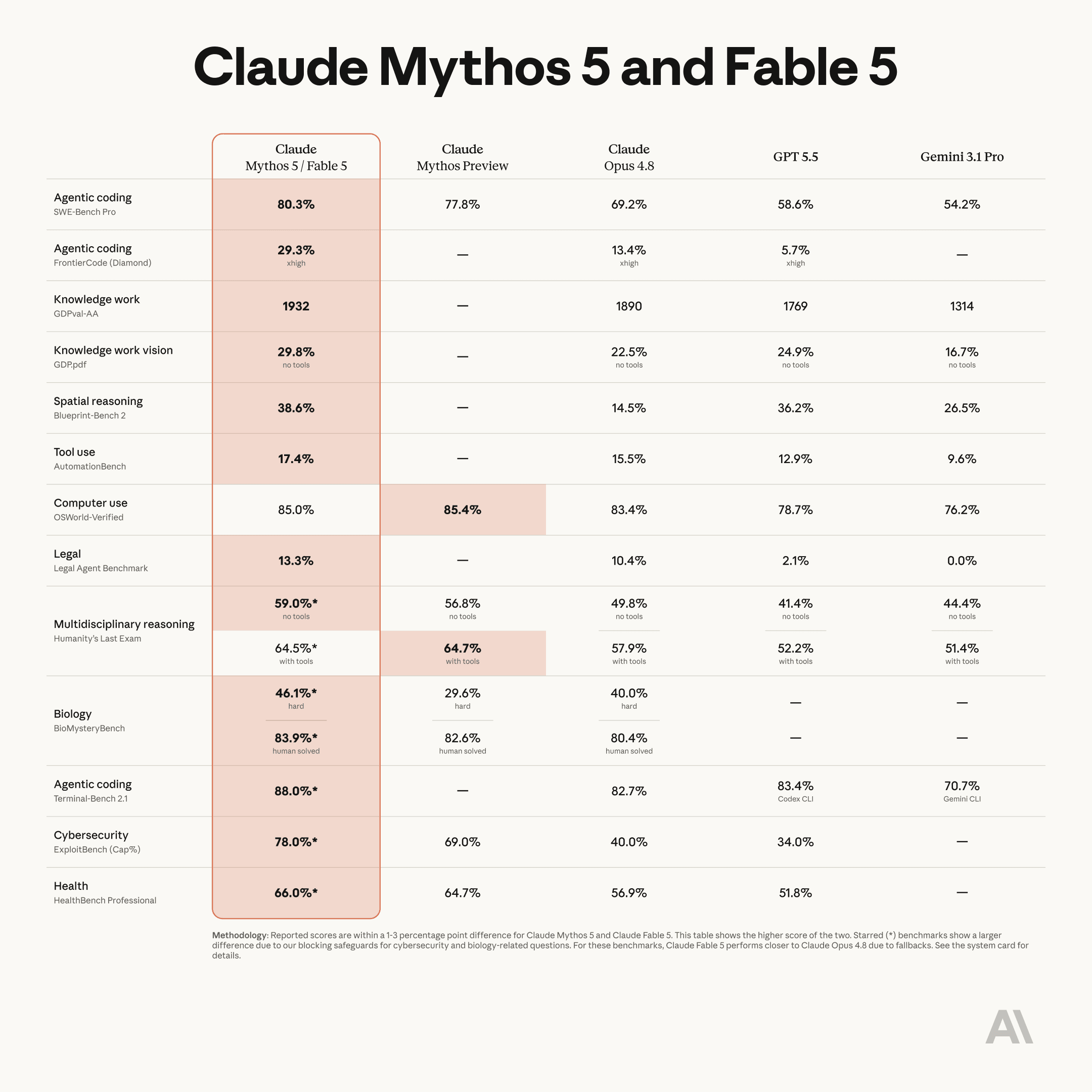
On coding, according to CursorBench, the new model is 20.9% better than Opus, which is really nice, but it's also much more expensive. It costs 2x more per token and, according to CursorBench, 2.45x more per task. Ouch. Not to mention that it will soon not be available in any plan, not even the most expensive one, and will only be usable through credits or the API.
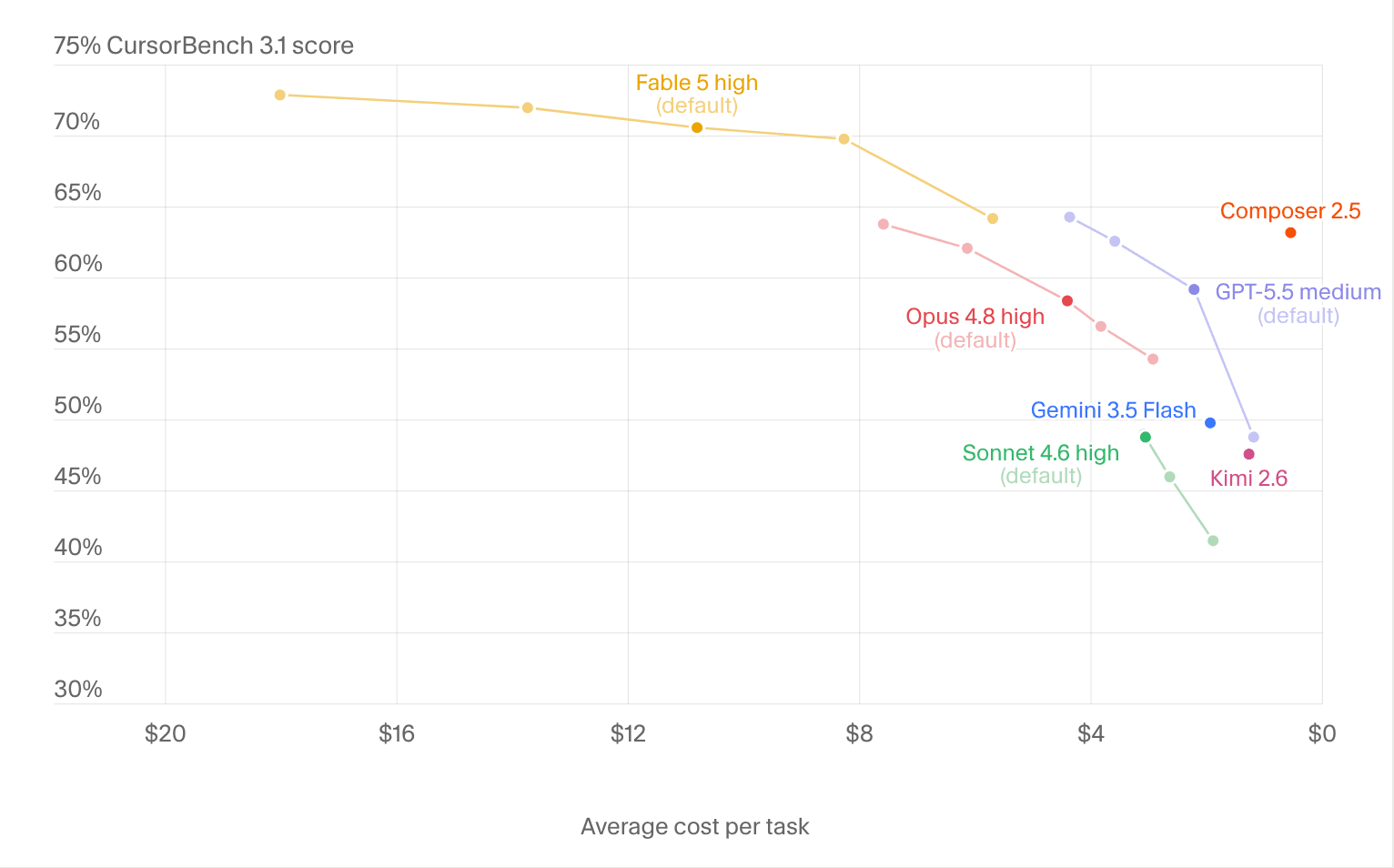
I remember when Opus 4.6 launched not too long ago, and people were already mind-blown by its capabilities, and its high price.
Clearly, the strategy to make you pay for the enormous, multi-billion-dollar AI costs is to launch new models that are a bit better but much more expensive, convince you that's a good thing, and then later deprecate the cheaper model that was already working fine for you. That's already happening, on Doctor Wise, one of the models we use is getting deprecated an the newer one despite not being any better for our use case, costs 2x more.
The part that actually caught my attention
But what really caught my attention was when one of the presenters in Anthropic's release video mentioned that Fable could "operate for days without intervention."
And I was like: Why???
It's already so easy to lose track of what AI is doing within a project, and that's a big issue most devs are facing right now. AI already writes code much faster than any human developer can keep up with. And no matter how good AI gets, humans will still need to understand, maintain, and control processes and codebases, and own the output.
Don't get me wrong, I've seen what it can do. From a simple prompt, you can create a whole new app or website with fancy features and interactions. But is using it like this actually any useful? Sure, the output is impressive and it looks great, but is it really what you need or want? Can a few prompts cover every requirement of a complex problem? For most cases, I don't think so.
Real-life problems are very messy, full of nuance, and usually the requirements are found through research, discussions, and many micro-iterations on many small parts of a problem until the "solution" or the production-ready state of a design or product is found.
If you delegate all decisions to AI, it will drift from what you need or want, and the longer it "operates with no intervention," the more it will. Humans need to be constantly course-correcting, and that's why it's so important to actually know what you're doing while using AI. If you don't, you won't be able to steer the ship: things will break, you won't be able to fix them, and the worst part is that you'll have wasted your time. I talk more about this in my last article, check it out.
The bottleneck isn't the model, it's us
This is not an AI problem. The bottleneck on productivity is no longer the AI model. The bottleneck is 100% human. Humans need to decide, design, review, correct and maintain. And this new model, despite being capable of doing more with no intervention, doesn't change that. Letting it do more with no oversight may just end up with it doing more of what you don't need, and making you waste time fixing it afterwards.
So I wonder why and when I, or you, would need a model like this, if the current cheaper ones are already delivering. It seems overkill for most people. The only use case I can think of for myself is as a fallback for Opus if/when it struggles with something, I think it could mostly happen with things related to vision, like some design and frontend fixes, but rarely.
Oh, and about your data
And just a heads up: Anthropic will hold your query data for 30 days if you use this model, supposedly to flag jailbreaking attempts. But who knows, they could very well use it to train their models. I don't see why they wouldn't.
Where I think this is heading
My personal view of this industry is that cheaper models should eventually dominate. They're the ones that actually make sense for most tasks, use cases, and workflows.
Smaller, cheaper, specialized, and more efficient models are the future. Eventually we should have powerful-enough models running on our own devices, and that's why Chinese AI is getting so much traction, and why Apple isn't investing in AI capex. Apple knows their consumer hardware may very well be capable of delivering on most users' AI needs. And companies like Airbnb and Pinterest are already turning to Alibaba’s Qwen model for many of their workloads.
In a near future it won’t make any sense to finance Anthropic's or OpenAI's colossal AI bills by paying for their costly models, if you could just get stuff done for pennies using Chinese AI, or run the models on your own laptop for the cost of your own electricity.
TL;DR
So, to sum up: I think for some niches and use cases this new model can be quite great, like in labs, maybe for doing code migrations or security reviews. But for everyone else, for most use cases, I think it's completely irrelevant, if not a waste of money.